- About DPH
- Our Services
- Our Programs
- Healthy Living
- Records, Permits & Licensing
- Knowledge Sharing & Collaboration
- Diseases & Conditions
- Training

Search
Frequently
Asked Questions
Asked Questions

Environmental Health
Helpful Links
Childhood Lead Prevention Program
Children's Environmental Health Program
Lead and Children
Lead in Housing
Related Documents
in Spanish
in Spanish
Childhood Lead Prevention Program: Parent Information
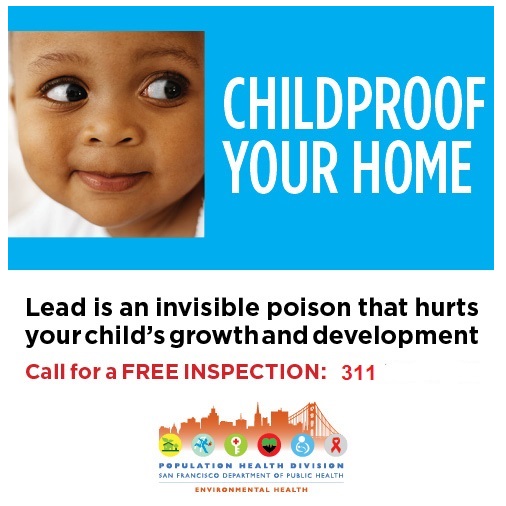
Where does lead come from? How are children exposed?
Lead is a common environmental contaminant because in the past, lead was widely used as an ingredient of house paint and gasoline for motor vehicles, and also due to the fact that lead cannot biodegrade. Beginning in the 1950s, some U.S. paint manufacturers began to voluntarily reduce the percentage of lead in residential paints, and in 1978, the Federal government eventually banned the manufacture of residential lead paint. Leaded gasoline for motor vehicles was no longer available in the United States after December 31, 1995.
In San Francisco, City agencies have the right to assume that all pre-1979 buildings have a lead paint history. When paint on pre-1979 buildings is damaged by a lack of maintenance or disturbed by renovation activities, lead dust is created and deposited on the home's interior and exterior surfaces, as well as the soil surrounding the home.
These conditions are called lead hazards. Young children are much more likely to be exposed to lead hazards because they touch lead-contaminated surfaces and then put their hands in their mouths. In addition, children's bodies absorb more lead than adults bodies do because they are still growing.
- Health Hazard Advisory to Parents - Trilingual English, Spanish & Chinese
- Lead is a Poison: Sources of Lead - Also available in Spanish & Chinese
Why and when should children be tested for lead?
Lead is a poison that may seriously affect health, learning ability and behavior. Only a blood lead test can tell you if your child has been exposed.
All children should be tested for lead at their annual checkup at least once before age six. Children who may be exposed to lead because they spend time in houses or buildings built before 1979 should be tested twice -- once at age one and once at age two.
- Getting Your Child Tested for Lead - Also available in Spanish
- Free or Low-Cost Health Care Bookmark - Also available in Spanish & Chinese
What do blood lead test results mean?
- Blood lead levels: What do they mean? - Also available in Spanish & Chinese
What are lead hazard violations? What can parents do to prevent exposure?
The San Francisco Childhood Lead Prevention Program provides services and information to identify lead hazards and prevent children's exposure to lead.
- If a child under six years old can be exposed to lead hazards, it is considered a violation of the San Francisco Health Code.
- If renovation and repair work on a pre-1979 building is not properly contained, and all dust and debris generated subsequently cleaned up, it is considered a violation of the San Francisco Building Code.
- The State and Federal government have additional laws requiring lead safety training and certification of all whose work affects lead-painted surfaces.
Please call 311 to request a free assessment to identify lead hazards in your home or childcare facility and to find out about resources for fixing those hazards.
For testing of lead in tap water
- Download the application for lead testing analysis and call (415) 551-3000 for scheduling test. The cost is $25 per sample.
- WIC-enrolled families may have their water tested for free. Call your WIC office for a voucher, and then call (415) 551-3000 to schedule.
Additional Resources
- Simple Steps to Protect Your Child From Lead - Also available in Spanish & Chinese
- Childproof Your Home Improvements
- Renovate Right - Also available in Spanish & Chinese
- Lead-Safe Gardening Practices and Gardeners page
- Lead in Consumer Products and Candies